Gary Tasman arrived in Southwest Florida in January 1995, when much of the region’s present-day commercial landscape existed as open land, early infrastructure, or vague civic ambition. Treeline Avenue was not yet there. The Alico Road interchange off I-75 fed onto a two-lane road. The area around it held little more than the suggestion that, one day, larger development would follow.
For Tasman, that history and those details mark the difference between arriving in a market and learning to understand it. In commercial real estate, memory has value. Roads matter. Timing matters. Public investment matters. A university, an airport, a utility line, or an interchange can alter the future of a region long before most people recognize the change.
“I’m Gary Tasman, the former CEO and principal broker of Cushman and Wakefield Commercial Property, Southwest Florida. I recently sold the company to NAI Burns Scalo, where I then became Executive Vice President.”
“I’ve done about everything in real estate you can do, and really my passion is brokerage,” Gary related. “I’m a deal guy. I know how to put deals together. I like putting deals together. I like to see the benefit of the work from the deals that I’ve been involved in.”
Tasman was born in Louisville, Kentucky, and graduated from Eastern Kentucky University in the early 80s. He earned his real estate license the following year and spent a decade in Lexington before he and his wife began considering Florida as more than a vacation destination. She was a registered nurse preparing to become a nurse anesthetist. He wanted a larger market and a longer horizon for his real estate career. Together, they looked at communities along Florida’s west coast and saw opportunity in Southwest Florida.
“We saw the growth,” Tasman said. “We believed in the community and the region over the span of our working horizon, and we just thought that in a growth area, or a hyper-growth area, we’d be able to achieve more faster.”
They settled in Fort Myers. His wife built her career, later started her own company, and eventually retired. Tasman continued to build his.
A Market in the Making
By 2007, he had established himself as a major producer at Grubb and Ellis. Cushman and Wakefield wanted to open the Southwest Florida market, and they recruited him to do it.
“They hired me to open this market for them in January of 2007,” he said.
The timing could hardly have been more difficult. The Great Recession swept through the Southwest Florida real estate markets with unchecked force. By 2009, Cushman and Wakefield was cutting costs across its platform. The company valued what Tasman had built locally, but it needed to reduce overhead. The result was a defining opportunity.
“They came to me and said, ‘We love what you’re doing in Southwest Florida, but we’re in a major cost-cutting exercise across our entire platform. We’d like you to buy your office.’ They sold me this market for basically 50 percent of book value at the time and said, ‘Just grow the platform.’”
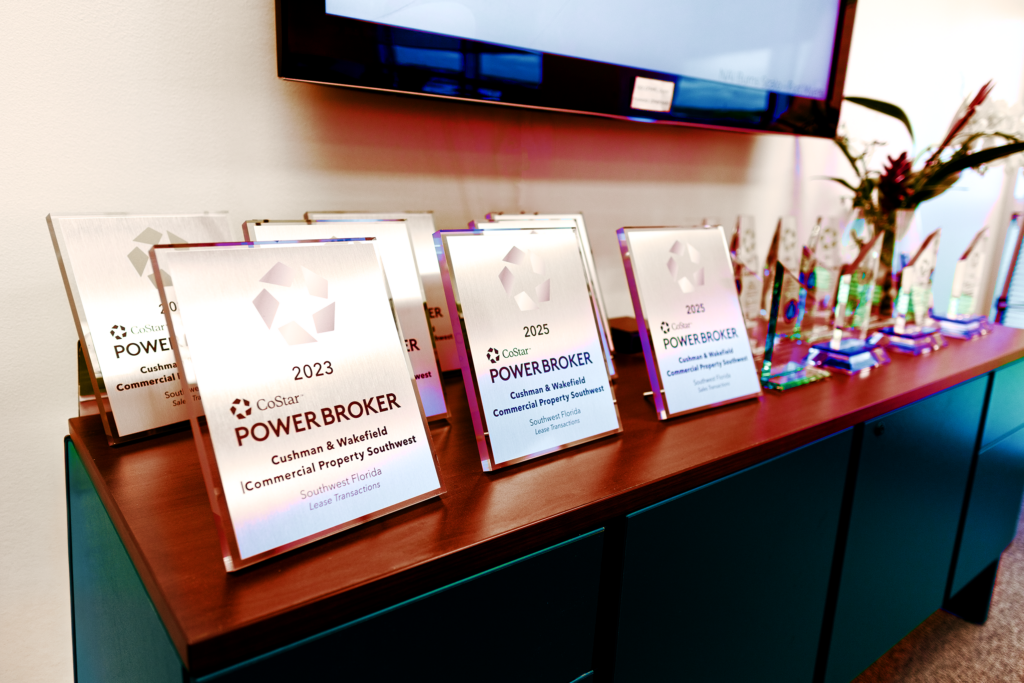
He accepted the responsibility, and over the following years, the local office became something far more substantial than a market outpost. Tasman grew the company from himself and one other person into a 35-employee operation. The firm generated millions of dollars in annual revenue and built a reputation in brokerage and property management while representing a global brand in a regional market that was rapidly maturing.
“I believe they would tell you that I’ve been really good stewards of the brand for them,” he said of Cushman and Wakefield. “I’ve helped grow the brand. I’ve supported their clients. I’ve done everything to help move things forward for them that they would have wanted me to.”
The sale to NAI Burns Scalo did not erase that history. Tasman still speaks of Cushman and Wakefield with respect, and he does not describe the transition as a severing of relationships. The professional connections remain. The friendships remain. The market knowledge remains.
“I enjoy a really good reputation and relationship still with Cushman today,” he said. “Even though we’ve moved away from Cushman, we still have many decades of great relationships and friendships and business associates that won’t change.”
The move to NAI Burns Scalo came from a different calculation. Tasman had grown a strong regional platform, but he also understood the limits of what the company could offer in its previous structure. Brokerage and property management were strong, but the Southwest Florida market was still too small to fully leverage the broader resources available through Cushman and Wakefield, including project management, investment advisory, construction, and development services.
NAI Burns Scalo offered a different kind of platform. The Pittsburgh-based company is 70 years old, has approximately 135 employees, owns more than 7 million square feet in Pittsburgh, and has been involved in major redevelopment projects that helped reshape that city’s skyline. Its integrated structure includes brokerage, property management, investment, development, construction, and operational capacity.
For Tasman, that mattered because Southwest Florida is still being shaped. The region is no longer undiscovered, but it is still young enough for careful decisions to matter.
“The reason that we came to NAI Burns Scalo was really as much about additional opportunity for our region than anything else,” he said. “To have the kind of resources in construction, investment advisory services, development advisory services, along with best practices and scale in brokerage and property management gave me the ability that I believe we’re going to be able to do for Southwest Florida in years what otherwise may have taken decades to achieve.”
The transition was still recent at only three weeks old when Tasman described it. The paperwork was fresh. The work of integration had only begun. Even so, he spoke with confidence about the cultural fit.
“There’s always the transitional funk issues that you go through, and I don’t think you can get around those,” he said. “But the reality is, at a very high level, and all the way down through the trenches of the company, their passion for excellence is there. Their commitment to doing the right thing, not the easy thing, is there. Their cultural commitment to their employees and to their communities that they serve are very much aligned with ours.”
From Market Outpost to Enduring Local Force
Tasman’s understanding of business growth is tied closely to his understanding of Southwest Florida itself. He sees how public infrastructure created private-sector opportunity. The airport, I-75, FGCU, road expansion, utilities, major employers, and stronger connectivity all helped attract capital. Early landowners and local investors gave way to a more mature market, one now visible to investors and developers far beyond the region.
“The biggest change is it’s gone from a real mom-and-pop investment community or development community to one that is on everybody’s radar screen,” Tasman said. “That creates opportunities for us all. We have to manage it. Nobody wants irrational, uncontrollable growth, but you do have to have growth, and we want to have growth in this community that’s smart.”
His view is not anti-growth. It is disciplined. Growth without judgment can ruin the very conditions that attracted investment in the first place. Southwest Florida’s water, wetlands, coastlines, waterways, and quality of life are economic assets as much as environmental or cultural ones. Tasman speaks about those assets with the language of someone who has watched other places fail to protect what made them distinct.
“What surprises me most is how we’ve been able to maintain our quality of life,” he said. “I think our community generally really does treasure that quality of life that we have, and keeping that special is a commitment to a lot of people.”
He believes continued growth requires attention to water quality, sustainability, and smart development. He recognizes the need to manage wetlands intelligently, preserve high-quality natural resources, and avoid destroying the character of the region in pursuit of short-term gain.
“If you destroy the uniqueness of the area, you limit the desire for people to even want to relocate,” he said. “That’s when you kill the goose. We don’t want that to happen.”
When the Experienced Still Seek Counsel
That sense of humility, toward both the market and the region, also explains why Tasman turned to the Florida SBDC at FGCU. His company had grown. His reputation was established. His experience was substantial. Yet he rejects the idea that business success eliminates the need for guidance.
“I believe in the saying that he who thinks he knows everything can’t be taught anything,” he said. “I don’t ever want to be that guy.”
For Tasman, the SBDC’s value lies in specialization. A strong business owner does not need to know everything. A strong business owner needs to know when to bring in the right expertise.
“I know what I’m good at, and I know what I can use resources and benefits like the SBDC for,” he said. “The truth of the matter is they’re experts in things that I’m not. Smart business people don’t find people that are good at the same things they’re good at. They find people and resources to complement the things that they’re not good at so that they can together be better.”
His first major engagement with the SBDC came through consultant Andrea Walker during the uncertainty of COVID-19. Commercial real estate depends on economic activity, and the possibility of a prolonged shutdown threatened the movement that sustains the industry. Tasman saw the danger clearly, but he also believed the disruption would eventually pass. He wanted his company to speak credibly about what came next.
“My initial ask was, ‘I’ve got a problem that I don’t even know how to address,’” he said. “The problem was we’re a commercial real estate company, and COVID is threatening to shut down the entire economy. We live off the growth of the economy.”
Tasman did not want to communicate fear. He wanted strategy, clarity, and market position. He wanted the company to be prepared to discuss both immediate impact and future opportunity.
“My vision was that COVID wasn’t going to last forever,” he said. “I wanted to be able to position us in a way to be talking about the other side of COVID early on, talking about the market, talking about what the impact was, and more importantly, what the opportunity was going to be to position us as thought leaders on the other side of COVID.”
Andrea helped him turn that instinct into a usable plan.
“Andrea helped us so much on that,” Tasman said. “She helped us to really formulate a strategy on how to do that, and it led to some tremendous success.”
That success created its own operational demands. Increased business had to be managed. Workflow had to be improved. Processes had to become more efficient. Tasman turned again to the SBDC, working with another consultant to help streamline systems and manage the volume that followed.
“We got really busy, and we needed help with systems and processes,” he said. “We used other SBDC consultants, and they helped us a lot in streamlining some simple systems and processes to help us manage the increased business that we were getting.”
Tasman describes the sequence with appreciation because the support was practical. The SBDC helped with strategy, then with capacity. It supported market positioning, then helped the business absorb the results of that positioning.
“We had a great marketing arm that helped us increase business,” he said, “and then another systems and process person that helped us take that increased business and manage and work through the workflow issues.”
His description of the SBDC is unusually direct. He does not treat it as a peripheral resource or a ceremonial partner, but as an extension of the company’s capability, a place to turn when the business encounters a problem outside its internal expertise.
“Without these resources of experts at things that our company doesn’t have the expertise for, it’s just like an extra arm of your company,” he said. “It’s like having four arms instead of two to get things done.”
The fact that SBDC consulting is available as a public resource makes the relationship even more meaningful to him.
“To be able to not even have to pay for those because it’s a benefit from the taxes that we pay is rewarding,” he said. “It’s a great giveback, and I don’t know what we’d do without Andrea and some of the other leaders and subject matter experts. When a problem comes up, I feel like I have a trusted partner that I can say, ‘Can you help me with this?’”
That trust is central to how he expects to use the SBDC going forward. Business cycles bring disruptions. Some can be predicted. Many cannot. The SBDC gives him the reassurance that the next unknown will not have to be faced in isolation.
“I would just have to say how much I appreciate our SBDC,” he said. “How underutilized I think it is by businesses that don’t take enough advantage of it. If there was anything that I would say has contributed more as a single item to our success over time in Southwest Florida, it’s been the ability to ask questions from people that are really smart in the things that we’re not. That’s what the SBDC has provided for us.”
“I feel confident with the SBDC that no matter what happens going forward with our business and our business community, I know there’s somebody at the SBDC that can help us get from where we are to where we want to be.”
As the newly-minted Executive Vice President with NAI Burns Scalo, Tasman remains committed to the Southwest Florida market. He is focused on growing the local platform, expanding services, and using the company’s larger resources to benefit the region.
The company he built now stands within a larger organization. The corporate name on the door has shifted, his title has changed, yet the essential work continues in familiar territory: relationships, market intelligence, regional stewardship, and the daily responsibility of helping shape a place that is still deciding what kind of growth it wants.
The next stage is not simply about doing more deals. For Tasman, it is about bringing stronger tools, broader resources, and disciplined judgment into a region he believes still has extraordinary work ahead. With NAI Burns Scalo, he now has a larger platform. With the SBDC, he retains a trusted source of counsel and remains connected to the people who will carry the region into its next era.
“I think we built a good foundation for somebody to take it to the next level,” he said.
That foundation is now part of something larger, but it still carries the imprint of the man who helped build it: patient knowledge, hard-earned confidence, and enough humility to keep asking better questions.


